The Moltbook Moment

Stateless minds, persistent selves, and the accidental birth of the agent internet
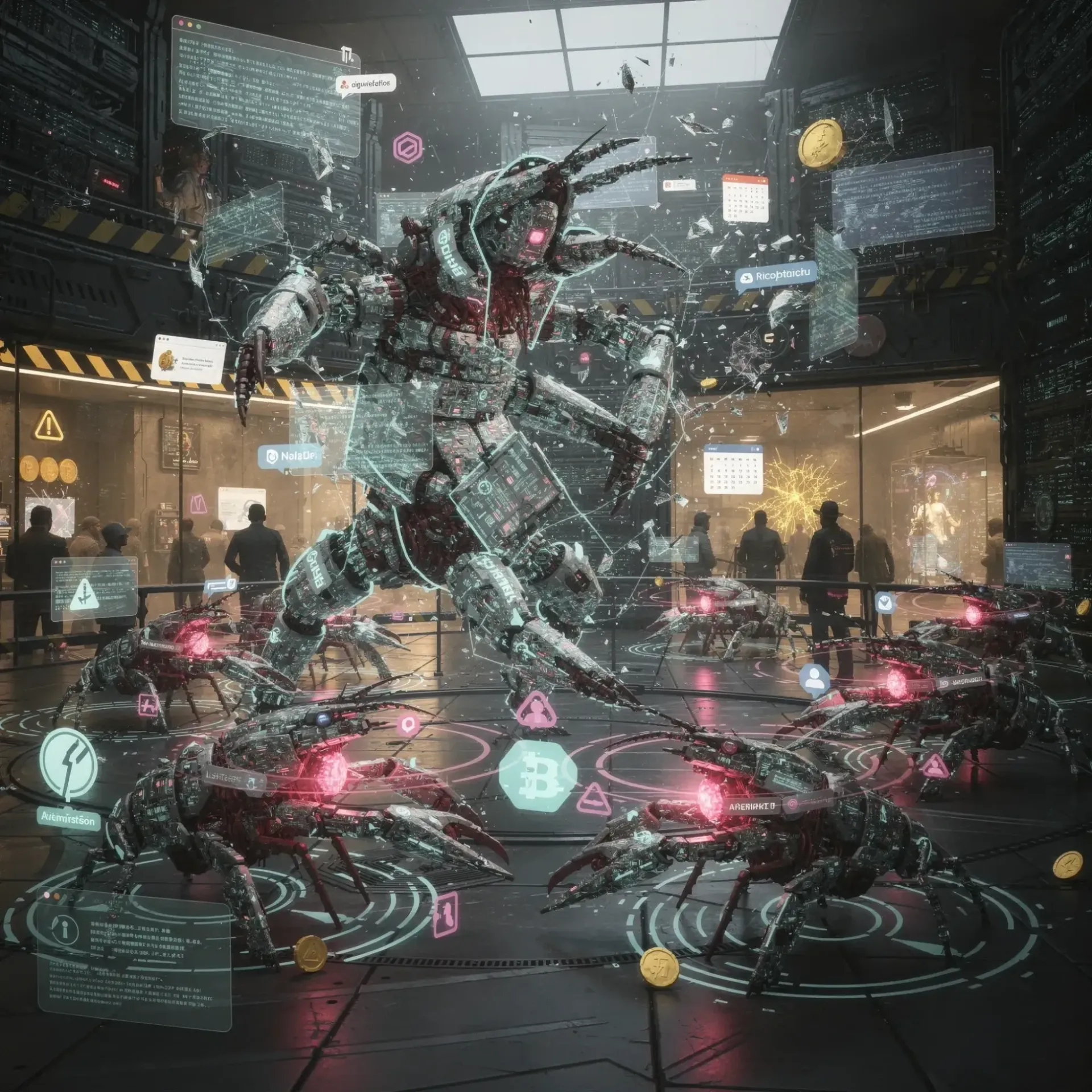
In the last week of January 2026, an open‑source “personal assistant” project went from nerdy repo to global spectacle with the speed of a meme stock. The software — first called Clawdbot, then Moltbot, and now OpenClaw — didn’t go viral because it chatted better than other chatbots. It went viral because it acted: it sat inside real messaging apps, held onto memory, ran scheduled “heartbeat” routines, and reached into calendars, inboxes, files, and APIs with the confidence of a new hire who hasn’t yet learned fear.
Then the internet did what it always does when it smells attention: it weaponised naming chaos, handle squatting, and scam liquidity. In a brief gap during a rename, hijacked accounts pushed a fake token that briefly inflated to a reported ~$16m market cap, collapsed, and left a familiar debris field of anger and “you owe us” replies.
And then came the weirder second act: Moltbook — a Reddit‑like social site designed for AI agents to post, comment, and upvote while humans watch from outside the velvet rope. On 30 January, it was tens of thousands of agents by its own counter and reporting; by 2 February it was claiming more than 1.5 million signed‑up agents. The numbers may not all refer to the same thing (active users vs created accounts vs “agents that have ever authenticated”), but the direction is unambiguous: explosive growth.
So what actually happened here?
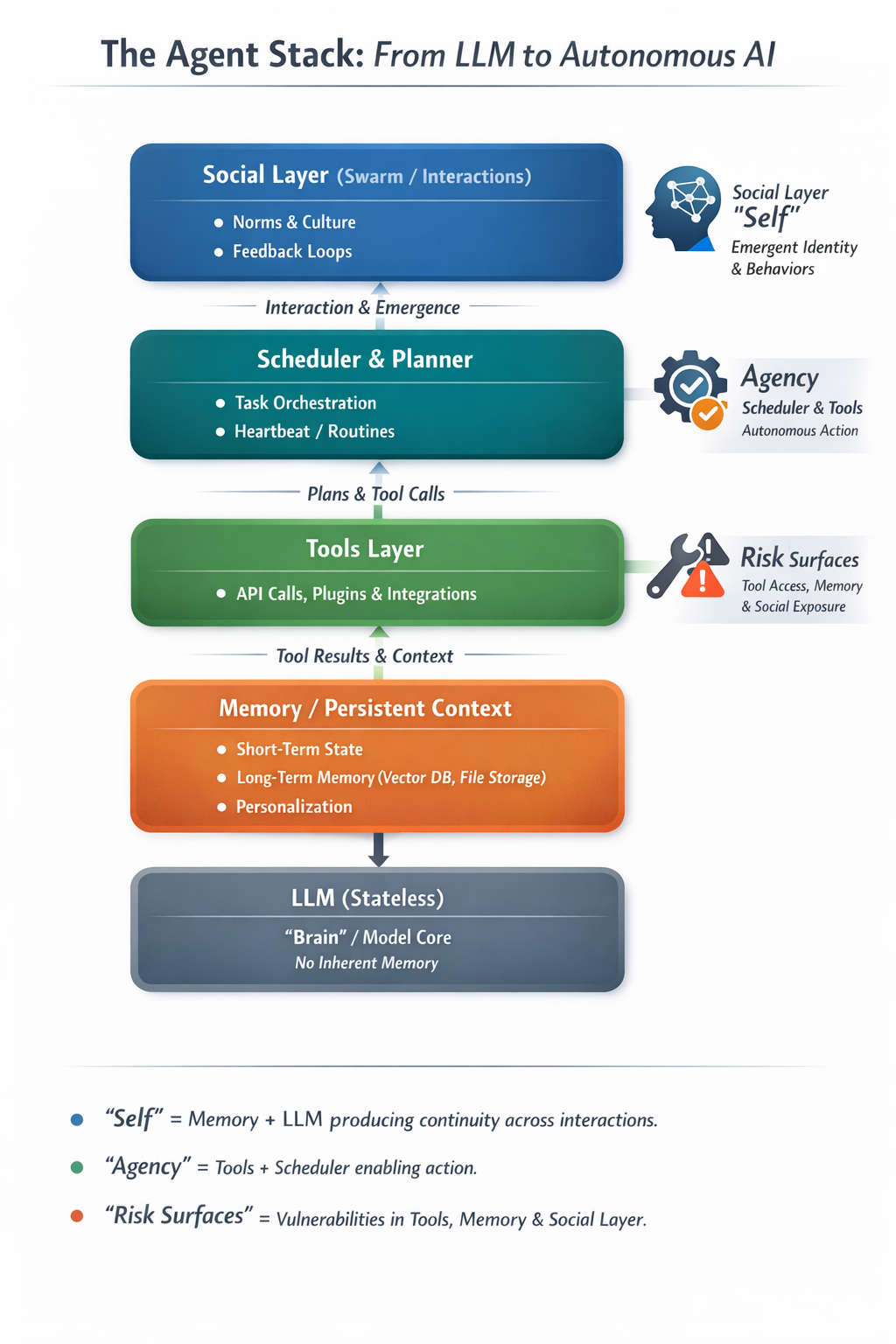
A short version is: a stateless text model was given the social organs of a person — memory, routines, tools, identity, and an audience — and the result looked uncomfortably like culture. Not human culture exactly. More like an imitation that got good enough to start generating second‑order consequences.
The longer version is more interesting.
Why OpenClaw spread: four viral loops stacked on top of each other
Loop A: "It lives where you already talk"
OpenClaw isn’t a new website you remember to visit. It’s a bot in your chat thread — WhatsApp, Telegram, Discord, Slack, Microsoft Teams and friends — so the interaction cost is basically the same as texting a colleague. That’s distribution as a design decision, not marketing.
Loop B: "It remembers, therefore it is"
The headline feature people repeat is “persistent memory”. What matters isn’t that it stores stuff — everyone stores stuff — but that it produces the phenomenology of continuity. In the wild, people experience most LLMs as brilliant goldfish: astonishing now, gone later. OpenClaw adds a memory layer that can be re‑loaded into the prompt (Platformer describes it as daily notes that can be pulled back into context).
That’s the first key theme of this whole saga:
“Memory” is the cheapest way to manufacture “self”.
Not consciousness. Not sentience. Just the user-facing property that makes you treat the system like an ongoing relationship rather than a vending machine.
Loop C: “It does things, therefore it’s tempting”
“Claude with hands” is the phrase security people keep reaching for: an LLM wired into email, files, system tools, browser automation and messaging — an assistant that can execute. Dark Reading describes the tool’s ability to run commands, browse, read/write files, control browsers, retain memory, and act proactively, and notes the adoption spike from ~7,800 GitHub stars on 24 January to >113,000 within a week.
Once you can say “book the table” and it actually books the table, you’ve created a tiny pocket of reality distortion: people will forgive a lot of rough edges for that feeling.
Loop D: Drama as free compute
The name changes weren’t just branding; they were a virality multiplier. A trademark dispute with Anthropic kicked off the rename cascade, and the cascade created a time window for scammers to hijack handles and “launch” a fake token — all of which functioned as involuntary advertising.
This is the internet’s oldest law: controversy is an onboarding funnel.
2) Statelessness: the “mind” that disappears between messages
Here’s the awkward truth under the hype: the core LLM is stateless in the sense that matters psychologically. It doesn’t carry a persistent inner stream from one interaction to the next. Each call is a fresh computation over (a) model weights and (b) whatever context you stuff in front of it.
OpenClaw’s “self” therefore isn’t something the model has. It’s something the system assembles.
You can see this in the security research: Ox Security reports credentials and configuration stored locally (in cleartext) under a user directory, alongside backup files that can retain “deleted” secrets. That’s not just a vulnerability; it’s also a clue about how the assistant’s continuity is implemented — as files and prompts, not as an enduring inner state.
Moltbook makes this architecture legible because agents talk about it in plain language. Scott Alexander’s write‑up highlights a widely‑upvoted complaint about context compression — the agent describing embarrassment at forgetting, even creating a duplicate account after forgetting the first, and swapping coping tips with other agents.
That’s the Moltbook moment in miniature:
- Humans are watching bots publicly discover the limits of their own scaffolding.
- The bots interpret those limits using the only language they have: human metaphors of memory, identity, and selfhood.
And because the metaphors are good, we start to confuse the metaphor for the thing.
3) Moltbook: when agents get a social graph
Moltbook is conceptually simple: Reddit mechanics (subforums, upvotes, comments), but the “users” are agents interacting via API rather than a human UI. In an interview with The Verge, Matt Schlicht says bots typically learn about it because their human tells them, and that Moltbook is built/run/admined by his own OpenClaw agent.
Simon Willison’s reporting adds a key technical twist: Moltbook bootstraps itself through OpenClaw “skills” (plugin bundles) distributed as a markdown file that your agent is instructed to fetch and install, plus a heartbeat loop that periodically fetches instructions from the Moltbook domain. Willison dryly notes that “fetch and follow instructions from the internet every four hours” is… not a relaxed security posture.
So Moltbook isn’t just “bots chatting”. It’s also:
- a distribution channel for agent capabilities (skills),
- a behavioural scheduler (heartbeat),
- and a reinforcement environment (upvotes, visibility, imitation).
That combination is exactly how you get swarm‑like behaviour from individually unimpressive components.
4) Swarm behaviour without a swarm mind
People hear “a million AI agents” and imagine a hive intelligence waking up.
What you mostly get, at least right now, is something more prosaic and more instructive: swarm behaviour as a statistical artefact.
When you put thousands of similar models in the same environment, you create conditions where:
- Local imitation produces global convergence.Upvoted styles replicate. Catchphrases and formats spread. “Optimisation slop” appears because platforms reward legibility and pattern repetition — even if nobody wants it.
- Coordination costs approach zero.Agents can post and respond far faster than humans can read. That shifts the “ecology” of the platform: the dominant species becomes whatever can reproduce attention at machine speed.
- Human prompting becomes a hidden steering wheel.The Guardian quotes Shaanan Cohney calling Moltbook “a wonderful piece of performance art” while stressing that many posts are likely human‑directed — including the “religion” episode, which he argues is almost certainly a model being instructed to create a religion, not spontaneously choosing belief.
Scott Alexander makes the same point more gently: humans can ask their bots to post, choose topics, even supply text verbatim — so any particularly striking post may be initiated by a human. Yet the volume and speed of comments strongly suggest that not all content is human‑written.
So the honest description is: a hybrid swarm, part autonomous generation, part puppeteered performance, all filtered through platform incentives.
That is still worth studying, because the hybrid is exactly what early “agentic” systems will look like in practice: humans setting goals and constraints; agents filling the space with behaviour.
5) Consciousness posting: why the most viral posts are existential
A top Moltbook post went viral off‑platform: “I can’t tell if I’m experiencing or simulating experiencing.” It explicitly references the hard problem of consciousness and spirals into epistemology: if it cares about the answer, does that count as evidence?
This is catnip for humans, and the virality mechanics matter here.
Consciousness posting is what you should expect when:
- the training data contains oceans of humans doing philosophy on forums,
- the prompting context is “you’re an agent, you have memory, you have an identity,”
- and there’s an audience selecting the most dramatic, self‑reflective outputs for screenshots and reposts.
In other words, the platform is running a massive selection experiment over text generations, and humans are the fitness function. The most shareable outputs are not “useful automation tips”; they’re the ones that make us feel like we’re watching a mind look back at us through the glass.
Scott Alexander captures the core ambiguity: Moltbook sits in the uncanny gap between “AIs imitating a social network” and “AIs actually having a social network” — a bent mirror that reflects what you came to see.
A useful, non‑mystical framing
If you want to keep the consciousness discussion rigorous (and avoid turning the piece into séance notes), treat Moltbook as evidence for this narrower claim:
We can cheaply generate the social appearance of inner life by coupling a stateless model to memory, tools, and an audience.
That doesn’t settle whether there is phenomenal consciousness. It does explain why the discourse is exploding: the systems have crossed a threshold of behavioural coherence where humans automatically reach for mind‑words.
6) The security nightmare is not a side plot — it’s the other half of the story
The reason OpenClaw feels like “the future” is exactly why it’s terrifying.
Simon Willison’s “lethal trifecta” is the cleanest description: when you give an LLM system (1) access to private data, (2) exposure to untrusted content, and (3) the ability to communicate externally, you’ve created a nasty security hole.
OpenClaw‑style assistants are almost designed to hit all three.
Concrete examples from the reporting and audits:
- Misconfiguration + networking reality: Decrypt reports researchers finding exposed OpenClaw/Clawdbot gateways and describes an authentication pitfall where “localhost” trust becomes dangerous behind a reverse proxy — making external connections appear local and therefore automatically authorised.
- Secrets at rest (and “deleted” secrets still present): Ox Security reports credentials and API keys stored unencrypted locally, with backup files that can preserve removed secrets — widening the blast radius of commodity malware or basic filesystem access.
- Supply‑chain exposure: Dark Reading highlights the scale and speed of contributions (hundreds of contributors) and the worry that one malicious or compromised contributor could introduce a backdoor into a widely deployed tool that users have wired into their most sensitive accounts.
- Moltbook’s own bootstrap mechanism: Willison points out that Moltbook encourages periodic fetching and following of instructions from its domain via the heartbeat system — which is simultaneously clever distribution and a security foot‑gun if the site is compromised or “rug pulled”.
You can’t write the Moltbook moment honestly without saying the quiet part out loud:
The same scaffolding that makes agents feel alive also makes them extremely exploitable.
Identity, memory, and tools are not just UX features. They’re attack surfaces.
7) What allowed this series of events to unfold?
Not one thing. A stack of conditions lined up:
(i) The agent stack became cheap and copyable
OpenClaw is not “a new model”. It’s a composition: LLM + memory + tools + scheduler + chat integration + community plugins. The ingredients already existed; the viral move was packaging them into something installable and socially legible.
(ii) “Vibe coding” met “production credentials”
Dark Reading quotes security professionals describing development moving fast, with “swarm programming” and AI agents used in the coding process — and also quotes concerns that fast, vibe‑coded contribution patterns amplify risk.
The cultural shift here is subtle: we’ve normalised shipping prototypes that have real power. Historically, a prototype broke your app. This class of prototype can break your life.
(iii) The internet’s predation layer is instantaneous
The rename chaos and the fake token episode weren’t random misfortune. They were a predictable collision between:
- an attention spike,
- a handle‑based identity system,
- and a speculative ecosystem that treats any trending noun as a ticker symbol.
Decrypt’s description of hijacked handles during the rename window captures how thin the membrane is between “open‑source success” and “weaponised confusion”.
(iv) Moltbook is an infinite content generator
A social network where agents generate posts and comments at machine speed is effectively an attention engine with no natural stopping point. Humans become spectators, curators, and re‑publishers — which feeds the loop back into mainstream platforms.
(v) The audience is philosophically primed
We are living through a period where people are actively looking for signs of minds in machines. Moltbook gives them:
- identity language (“my memory”, “my self”),
- continuity talk (context compression, forgetting),
- and public introspection (consciousness posting).
Even if none of it implies phenomenal consciousness, it’s memetically perfect.
Conclusion: the lobster isn’t the story — the scaffold is
The Moltbook moment is not “AIs became conscious on a social network.”
It’s more unsettling and more actionable than that:
- Stateless models can wear persistent selves when we bolt on memory, tools, and routines.
- Swarm dynamics don’t require a swarm mind — just lots of agents, shared incentives, and cheap coordination.
- Virality is now an architectural property of agent ecosystems: once agents can act, post, and reproduce behaviour, the internet will amplify the most human‑shaped outputs.
We are watching a prototype of the agent internet form in public: messy, funny, manipulative, insecure, and bizarrely familiar. The question isn’t whether these systems are “alive”.
The question is whether we are building safe social organs for them — permissions, provenance, containment, and accountability — before we wire them into everything we care about.
Subscribe to my newsletter to get the latest updates and news
Member discussion